
Key takeaways
- With credit under 600, look for funding backed by something other than your score: revenue, invoices or equipment.
- These options cost more, so borrow only what has a clear payback.
- Avoid anyone who charges an upfront fee to “guarantee” approval.
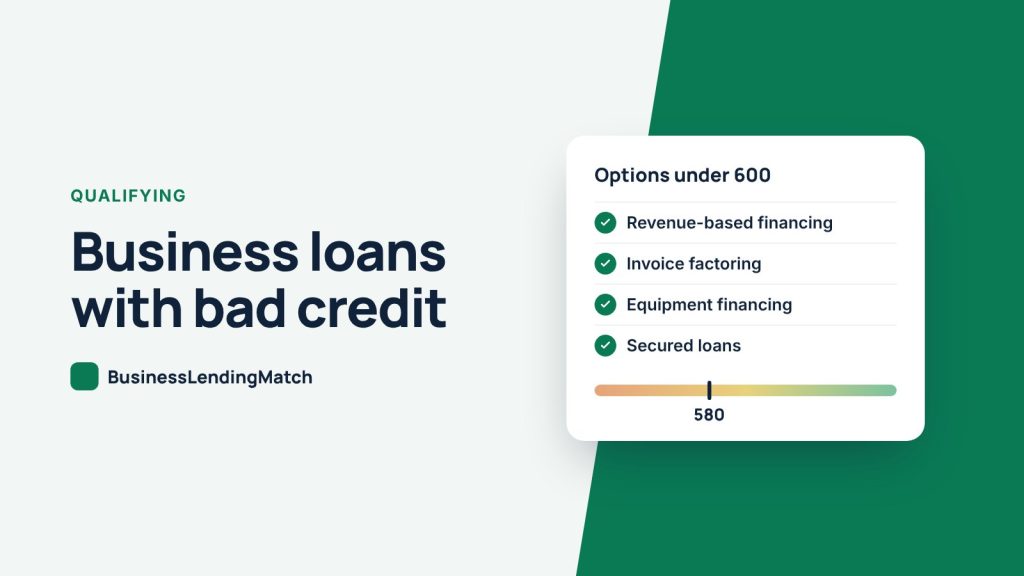
You can get business funding with bad credit, but usually from products that lean on something other than your credit score: your monthly revenue (revenue-based financing), your customers’ invoices (invoice factoring) or the equipment you are buying (equipment financing). Expect higher costs and shorter terms than a bank loan, and compare the total payback before you sign.
What counts as bad credit for a business loan
Most lenders group personal credit roughly like this: under 600 is challenging, 600 to 649 is fair, 650 to 699 is good and 700+ opens up the best rates. Banks and SBA lenders rarely go under 650. Many online lenders start around 600 to 625. Below that, the options below are where approvals happen.
Options that work with lower credit
| Option | What it relies on | Watch out for |
|---|---|---|
| Revenue-based financing | Steady monthly deposits | High total cost, daily or weekly payments |
| Invoice factoring | Customers who pay on terms | Fees that add up if customers pay slowly |
| Equipment financing | The equipment as collateral | Larger down payment with low credit |
| Secured loans | Real estate or other assets | Risk to the asset if you default |
| Microloans and CDFIs | Mission-driven lending | Smaller amounts, more paperwork |
How to improve your odds
- Show strong deposits. Three to six months of steady bank activity with few overdrafts matters more to these lenders than your score.
- Explain the credit issue. A medical event or a past business that closed reads differently from ongoing missed payments.
- Offer collateral or a down payment. It lowers the lender’s risk and your cost.
- Be upfront about tax liens or bankruptcies. Some lenders can work with them, others cannot. Saying so early points you to the right ones.
Traps to avoid
- Upfront “processing” or “guarantee” fees before you are approved. Legitimate lenders take fees from the funds at closing.
- Stacking several cash advances at once, which can quickly eat your cash flow.
- Offers that only quote a payment or factor rate. Ask for the total payback and the estimated APR.
- Forms that sell your information to a list, which leads to a flood of calls from brokers pushing the most expensive products.
A plan to move to cheaper funding
Treat bad credit funding as a bridge. Pay on time, keep your business account healthy and check your credit reports for errors. After 6 to 12 months of on-time payments and better credit, you may qualify for a term loan or refinancing at a lower cost.
Frequently asked questions
Can I get an SBA loan with bad credit?
It is difficult below about 650. SBA microloans through nonprofit lenders can be more flexible for smaller amounts.
Is a merchant cash advance a loan?
Usually not legally. It is a purchase of your future sales, which is why it often costs more than a loan. See merchant cash advance vs business loan.
Will checking my options lower my score more?
Getting matched with us uses no credit check. A lender may run a credit check later, only if you choose to apply with them.
Find a lender that works with your credit
Lenders that approve lower scores are hard to find without being spammed. Tell us about your business and we will match you with the vetted lender most likely to say yes. Get a Loan.